A few words about AI Product Manager skills
I hate to admit it, but non-technical product management is a thing of the past. A dinosaur hit by the AI meteor, so to say (🦖 ☄️ ☠️)
I have practical experience in both actively using AI in my work, and building and managing AI-based features and products. I've built askexpert.online, ideated and launched the AI SQL Copilot for BigQuery at OWOX BI, and managed the AI Sales Mentor based on Salesforce at RevenueGrid.
I don't even count small experiments with vibe coding, as it is a topic in itself. Surprisingly, the rise of AI doesn't mean that you can build stuff without technical knowledge. The wind blows in the opposite direction.
I hate to admit it, but non-technical product management is a thing of the past. A dinosaur hit by the AI meteor, so to say (🦖 ☄️ ☠️) .
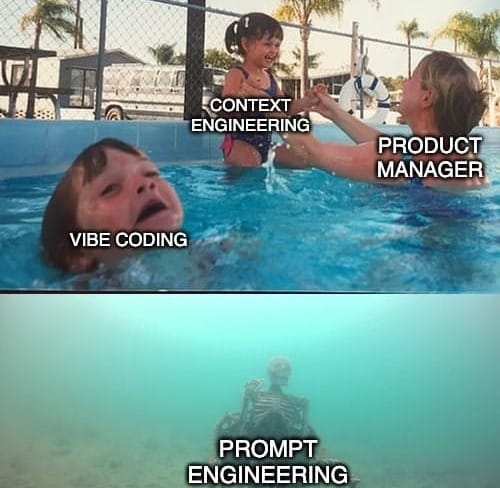
Prompt engineering won't impress anyone anymore. Context engineering is all the rage now. Here's a short list I composed for what you should know about AI context engineering if you don’t want to go extinct 👇
• Memory management (what to keep in the conversation? what to save for later and how?)
You should operate chunking rules, context windows, column types, and databases.
• State management (where is the user in the process?)
What are the conditions for success or failure? How do you pass context between stages? How should the AI respond? Measuring results with events and being able to build a funnel on the fly is a must.
• Context management (how to prevent context rot?)
More information isn’t always better; it can actually cause hallucinations. How much is too much? How does it impact the results?
• Tool calling & MCP servers (what functions to execute and when?)
You need to understand APIs, contracts, CRUD operations, access management, CRM workflows, and verification or authorization flows.
• Agentic workflows & system design (what is the best structure that will achieve the desired result?).
Pros/cons of programmatic vs AI-based agents, orchestrators, and conversational layers. You should be familiar with prompt-chaining, agent routing, parallelization, autonomous agents, and human-in-the-loop flows.
• RAG (retrieve only the relevant pieces of data for the task).
What part of which document should AI fetch? Vector databases and search are your best friends. Also, learn how AI handles unstructured data like PDFs and OCR.
• Prompt engineering (how to get the most accurate results while keeping token usage and cost in check).
Few-shot examples, context injection, and role modeling are already basics your grandma should know.
• AI Safety (protect the user and the brand).
Guardrails, Responsible AI policy, moderation, and data masking are just the starters to make sure the AI behaves well. You aren't building the next Grok, are you?
• Evaluations (how much does your AI tool hallucinate? how do your changes affect results?).
No one fully understands this yet, but you should at least measure latency, accuracy, and false positive or negative rates.
Also, know the difference between code-based eval and LLM-as-a-judge:
- code-based misses context
- LLM-as-a-judge is costly and biased at scale.
😅 Phew. And yes, all of this comes on top of the core skills of product management. User experience and customer retention are still king at most SaaS businesses, AI or not.
On my Linkedin, I've recently shared the most surprising thing I learned managing the AI product for enterprise customers.